Sunday, September 18, 2016

Happy Chuseok!

Annyeonghaseyo and Happy Thanksgiving! Yes, it's only mid-September, but in Korea, it's time to give thanks. This year, Chuseok (also known as Hangawi) fell during September 14-17, which meant a big break from school and work for everyone. During this harvest festival, Koreans reconnect with their heritage by honoring their ancestors and giving thanks for a plentiful harvest. They celebrate by visiting with extended family, playing traditional games, and eating typical foods.

On Tuesday the 13, the last day before Chuseok vacation, children all over the country went to school wearing traditional clothing, called hanbok. For women and girls, it is usually a full-length skirt made of silky material along with a short top with sleeves that ties in the front; for men and boys, it's baggy pants (think Aladdin-style) with a robe-like top that also fastens in front. The designs are bright colors and many have intricate designs, embroidery, stripes, and the like.


Have you ever seen anything cuter? (Ignore my oversized and unflattering rented hanbok!)

Tony's kids lined up to show off their hanbok, ready to bow.
When the kindies wore their hanbok to school, I about died from the cuteness. I love the pride that the Korean people have in their culture and heritage. Considering these kids are aged 5-7 and they likely won't fit into their hanbok next year, many of them still sported beautiful and high-quality garb.

On Chuseok Activity Day, I got to teach the kids how to play Yut Nori, a game based off Confucian principles that also incorporates symbols of the earth and the harvest season. Source

 
Tuesday was our special Chuseok Activity Day at school. We began the day with a comparison of Korean and American Thanksgiving, practiced the traditional Korean way of bowing, and did a fashion show so all the kids could boast their gorgeous regalia. Then, we played games like Tuho (throwing arrows), Catch the Tail (like flag football, without the football), and Yut Nori (I swear the game "Sorry" was probably based off of this ancient, original version). The children also got to design and decorate their own wooden top toys, and then they prepared Songpyeon, a type of glutenous rice cakes filled with mung beans that are very common to eat during the holiday. Legend says if your Songpyeon doesn't look pretty, your children will be ugly, so you'd better form that rice cake nicely!

Whoever prepared these songpyeon must have beautiful children! Source

As a foreigner, Chuseok was not only a well-deserved break from work and an excuse to go on a trip (which I'll detail in the next post), but it also served as a great opportunity to learn about Korean culture in a more hands-on way. I got to eat foods that I might not have tried otherwise, and learn the meaning and symbolism behind different customs and traditions. The other foreign teachers and I even got the chance to wear a hanbok during school! Of course, they looked more like giant nightgowns or bath robes on us because they were cheap material and weren't fitted for our bodies, but it was still fun to play dress up. Most of all, seeing the children celebrate and connect with their own culture in an environment where they're usually only exposed to our language and customs was rewarding... and of course, they looked way too stinking precious in their hanbok!

A blurry bow. Happy Chuseok!

Monday, September 12, 2016

Me in the Mountains


 On Saturday, our director Heather took us to hike Chiaksan Mountain, which is known as "Cure Mountain," as it has been known to heal the spirit, mind, and body. It was a perfect escape from the monotony of teaching and the stale city air.


The five of us scaled the trails at our own pace, and it was a gratifying challenge for body and mind. The climb was a distance of only some 3 kilometers, which seemed much less intimidating from the beginning - but I've been inert for some time, and as the pitch increased, my muscles ached and my breath grew labored and my will quavered, but my resolution solidified.


Keeping up with the two Korean teachers was a struggle, not only physically but also because they were so quick (used to the mountainous terrain, perhaps?), I felt as though I were missing the scenery. After all, the destination is miraculous, but the journey is gratifying as well. I could feel the air getting more and more pure, and finally we reached a tranquil spot to collect water and dig into our snack supply. It was a beautiful mashup of nuts and dried fruit and sweet potatoes and felt so nutritious and filling and fulfilling. We filled our bottles at a spigot of natural and pure water from the mountain, and its clean taste was remarkable.
After resting, we continued up and up, steeper and steeper still, until at last we caught a glimpse of our destination: Sangwonsa Temple, a buddhist speck in the mountains of Gangwon-do province.


The view from the summit was hazy but beautiful, and I had an unshakable feeling of pride for reaching my goal. The climb wasn't easy, and we still had to make the trek back down during which my legs would shake like jelly, but for the moment I felt as though I had shed the weight of the language barrier and the workload and all concerns. For a substantial amount of time I've felt far from God and from my family and all forms of comfort, but here there were no worries. Now it was just me in the mountains.


Friday, September 2, 2016

There's no answer 'cause it's the weekend

Our first full month has officially come full-circle, and no Friday has ever been more welcome. The cherry on top of this difficult week has included a child spitting a ball of chewed-up rice into my hand and a newly broken cell phone. TGIF.

In the spirit of welcoming the weekend, it's about time I share what Tony and I have been up to on our all-too-infrequent days of freedom. Besides, all work and no play makes Jack a dull boy.  With our first month complete, let's explore what we've done each weekend since we got here.

1st weekend: Korean barbeque with our fellow teachers, shopping for basics - groceries, home goods, etc - and lots of sleep.

Being touristy in Insadong
2nd weekend: We had a Monday holiday, so it was a long weekend, which we spent checking out some local cafés and restaurants. First, though, we had our staff retreat on Friday at a resort in the mountains. There, we got to know each other a bit more, and did some training sessions as well. On Monday, we took our first trip into Seoul. One of the Korean teachers at school lives there, and she took us around the city. We saw two neighborhoods: Gangnam (is the name familiar to you?), which is quite urban, and Insadong, which is more artisanal and attracts a lot of foreigners.  We tried bingsu, or ice milk, which is like ice cream but less heavy.  We had Chinese food - black noodles and sweet and sour fried pork. Yum! It was also our first time negotiating public transit - we took the metro into town (and got twisted around quite a bit) and returned by bus.


At a traditional tea house in Insadong


3rd weekend: Almost nothing! We were very lazy. We strolled our neighborhood, including the local open-air markets in the street, and we took the train to AK Plaza, a big seven-story shopping mall in downtown Pyeongtaek.

Downtown Pyeongtaek


4th weekend: Saturday was a field trip for the elementary kids at the water park, and we chaperoned. Water parks are super popular here; every Monday, at least a couple of students would tell me that they went to the water park over the weekend. Finally, we got to experience it! I chose to wear a one-piece swim suit with board shorts, simply because I was going to be around children all day and thought a bikini wasn't appropriate. Even then, I showed a lot of skin! Many of the kids wore full length pants and long sleeves. Also, the water park required something to be worn on the head at all times - a swim cap or hat. If it fell off in the pool, they'd blow a whistle and yell at you to put it back on! I've never seen so little skin at a swimming pool! only hands, feet, and faces showed. The hats are worn for hygiene and to keep hair out of the pools and drains. As far as the extensive clothing coverage, people want to stay as white as possible here. It's not like in the West where we lay in the sun or pay for sessions of spray tan or tanning beds!

5th weekend (now): We went out for kimbap (like a sushi roll, but loaded with different proteins and vegetables), mandu (dumplings), and topokki (type of rice cake). Not sure yet what else we will get ourselves into this weekend...

Next weekend, *edit: the trip to Crocodile Island sold out before we could book it, so we went to Chiaksan National Park to hike instead.* Then, we have only 2 days of school before Chuseok, Korean Thanksgiving. During the September vacation, Tony and I are going to Uleung-do island for a five-day trip. We've got a lot coming up in September! I can't wait to finally start exploring what this country has to offer!

Tuesday, August 23, 2016

Teaching in Korea

I'm tuning in for a quick, mid-week post since I was unable to write this weekend (and by unable, I don't mean too busy... rather, too lazy). As you know, the purpose of our stay in Korea - and the reason we were flown out and are now housed for free - is to teach! This has been a transition period for us not only culturally, but also into a new school, and in Tony's case, a new profession.

The KC staff is wonderful!!! We went on a training retreat to a resort in the mountains.

Our school is a private school called Kids' College. It's a small school with four classrooms, a kitchen, and an after-school nursery on the first level, and four classrooms on the second level as well as a "gym" (open space), and teachers' offices.

Morning time is for kindergarten, or kindy, as it's called here. The children are 5-7 years old Korean age (Korean age is +1; in Korea I am 25, but in the States I'm 24... you're considered 1 year old when you're born). My students are 5 years old, so really they're the same age as my nephew, who hasn't started formal schooling yet! Tony's kids are 7, so they're the most advanced kindy class. Mine is the newest... and rowdiest. The classes are rather small: I have 5 kids, and Tony has 6.


Me and my kindies on a field trip at the post office!
We report to the school by 9 (Tony and I like to arrive around 8:30-8:45 to prep), and the first kindy class begins at 9:30. From there, we teach 40-minute periods with 10-minute breaks between - and a lunch - until 2:00. It's five classes total: some arrangement of phonics, math, science, language arts, gym, music, story time, theme activities, and so on. Truthfully, the schedules are very complex - it's a lot to remember!

After a break between kindy and elementary, we begin teaching again at 2:30. All elementary students go to a different school during the day, and come to Kids' College for after-school programming. This is called "hagwon" in Korea, and it's very common. Many of our students are only 7, 8, 9 years old, but they report to various after-school activities, and it's not just soccer practice or girl scouts. They have piano lessons, martial arts, math school, or a variety of others, along with their English studies at KC. It's a lot of pressure - and homework! The kids often hint at how little free time they have day in and day out. We try to help them have a good time so that they see English as fun learning, not a chore.

Elementary students are aged 7-13, depending on the class. My classes are rather advanced, but Tony's are still pretty basic. In fact, he often tells me that his kindy kids know more than his elementary students! The class sizes are bigger after school as well, but still not as big as I'm used to in the States. The maximum students in a class is 14. In elementary classes, we focus on vocabulary, reading, speech or debate, and sciences.


Cute but evil >:)

Each day, we have a key sentence and 2-3 key words to teach the students at the beginning of class; these are used in their daily homework. Each student shares what's going on or how they're feeling, and then we sing a song and practice speeches. Then we get on to the lesson and activities.

The most demanding part of the job is certainly lesson planning. Our kindy lesson plans are due a week and a half in advance, each Tuesday. Elementary lessons are due Thursday. Between all the students' levels, the school subjects, the routines, and the textbooks, it's hard to keep it all straight, but after three weeks, we're finally starting to get into the swing of it.

Most of this has been quite technical, and I'll surely get into the day-to-day details of what it's like to work as an English teacher in Korea soon. If you have any specific questions, please ask in the comments! I'd love to share more with you.


Have you ever thought about teaching abroad? What do you think about the school system here?
Kindy craft - we made squid!

Sunday, August 14, 2016

Korean Culture: Wins and Fails

If you don't know much about Korean culture, I'm sure you've at least assumed that it is different from that of the USA. This far away from home, day-to-day things have required some adjustment. My research about such customs before our departure wasn't completely extensive, but even with the tips I did read about online or in print, there's a lot to remember! Let me tell you about some run-ins with Korean culture, and you'll see if I succeeded in negotiating the custom or if I fell flat on my face.

Respect
  • The Korean language and culture consist of hierarchical structures that distinguish different levels of respect. That is, if you're talking to someone older or with more authority, you must use a certain type of language that you wouldn't use with children or friends. (If you know Spanish, this is kind of like Usted versus Tú, except instead of just a different pronoun and slightly different verb conjugation, the entire system differs.) Example: Saying "hello" to an elder: "안녕하세요" (an-yong-ha-seyo), whereas with more familiar or less authoritative audiences, you can just say "안녕," (an-yong). Pro-tip: always use the more formal system. That way, you're not offending anyone, and those who don't require such respect would understand that you just don't know Korean very well.
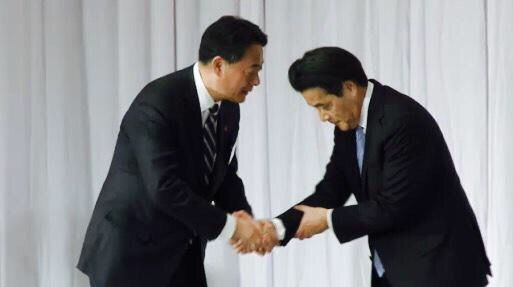
  • Another point of respectfulness focuses on the hands. If you're out to dinner, you shouldn't fill your own glass; rather, you should fill others' glasses and let them fill yours. When doing so, always use two hands. You can put both hands on the carafe/bottle or one hand on the other. The same goes when shaking hands: your right hand holds your new acquaintance's right hand, and you place your left hand on your own arm some where around your elbow, forearm, or wrist, or on the other person's hand. I was so stoked that I remembered to do this when I met the parents of one of my students (and, of course, greeted them with "안녕하세요")!!!
Notice the slight bow as well as the hand placement. Source

Attire
Slippers just for the bathroom. Source
  • The most noticeable and ubiquitous custom that we've found deals with footwear. When you enter a home in the West, it is customary to take your shoes off. However, it is not required. Generally, if you're at home, your shoes are probably off (unless you're my father-in-law :) ). If you leave your home and realize you forgot your cell phone, you'll likely run back inside, up to your bedroom, and back to the car without removing your shoes, right? Here, that is not the case. Shoes are reserved for outside. In in intimate setting like at home, or even at a traditional-style restaurant (you know, where you sit on the cushions on the ground), your shoes are expected to be off. Inside, your options are: barefoot, socks, or lounging slippers; even the bathroom has special slippers. At school, we teach in our socks or slippers, or even barefoot! (It is fun at first - I don't like to wear shoes much - but at the end of a 9 hour day, my feet are screaming! You don't realize just how much support your shoes give you until you give up working in them.) When our furniture delivery man came on our first morning here, he took off his sandals upon entering our apartment, and each time he would return to the hallway for another box of materials, he'd slip on his shoes. Simply to take them off again 5 seconds later!
  • I had learned that Korean culture is more conservative than I've found it to be in reality. The tips I had read suggested that tattoos are inappropriate (the head teacher at the school has quite a few, and they're visible), and that tank-tops are disgraceful, as a woman should cover her shoulders. Well, let me tell you: August is unbearably hot and humid, and I only packed a handful of tanks, assuming I'd just wear them at the apartment. Nope! I see women at school and around town baring their shoulders to the summer heat. I've been repeating clothing over and over because most of my clothes cover too much for this weather.
Superstitions
  • The director at our school warned us (a day after our arrival, mind you) to only run our air conditioning in fifteen-minute intervals, sparingly, because it's very expensive here. Oops! When we arrived from the airport, we cranked that baby to its coolest setting (I can't overemphasize how hot it is here) and slept all through the night that way. For the next couple days, we followed her instructions - the other Korean teachers at school agreed that it shouldn't be running constantly. After sweating in out in our sauna-home for a week, the "foreign" teachers (remember, that means Western) told us they run theirs all the time and that the natives exaggerate. Well, we haven't received a bill yet, so for the time being, we keep it off overnight and while we're at school but run it in the morning and before bed. So, we bought a fan. Koreans are big proponents of fans because they're so anti-AC, but they're also very paranoid about them! It is believed that if you sleep with a fan on in a closed room, you will die. I haven't yet figured out why that is - do they think it would electrocute you? or the cover would fall off and the blades could cut you? - but we did see (not hear, since we can't understand the language) a story on the news TWICE about fans catching on fire. Maybe that's how they'll kill you! But without AC all night, no fan is not an option. I'll take my chances - plus, our bedroom doesn't have a door... but that's a story for another day.
  • Never write someone's name in red ink in Korea! I had read about this (not sure if this is legend, but in the past, red ink was used in obituaries, so writing another's name in red was like a death wish), so I reminded myself to never buy a red pen so that I wouldn't do it on accident while grading a student's work. I had never considered that a white board marker would have the same effect! I was teaching grammar last week, and I made a sentence about one of my students: "Victoria is a good dancer." Immediately, my students screamed! I didn't understand their panic at first, but as they pointed in horror at the board, I realized my mistake. I quickly erased her name and rewrote it in black. Mostly, the class was laughing nervously - I think they know it's a simple superstition and that I meant no harm - but it certainly caused a panic in the classroom! I apologized to Victoria and wished her a long and prosperous life, and she laughed.
Well, these examples are only a handful of the dozens of differences we've found in this new culture, and I'm sure we've only found the tip of the iceberg. In moments like these, as a traveler and learner, it's important to remember that just because something is different doesn't make it wrong or stupid or silly. Culture shock is real, but embracing the newness helps a lot with the adjustment. What do you think of these customs? How would you react to these changes? Have you heard of any other Korean customs I should brush up on before another disaster?

Thursday, August 4, 2016

"Home"

To abate my sister's continual pleas, I present to you: Smartvill. Our new apartment and home for the next year!

This building is so new, there's still cardboard on the walls of the elevator, and the taxis don't know where to take us if we say the name of the place. My anxieties of pests and poor insulation subsided immediately. It's clean and bright and pretty high-tech. Samsung everything - TV, AC, video intercom, toilet/bidet, inversion washer/dryer, microwave. It even has a key-less code access and automatic, motion-sensing light in the entryway. Overall, we are very pleased.

Notice: no oven! To the right is our refrigerator, which disguises itself as a cabinet.

I have no idea how to use a bidet.


Walk-in closet but not enough hangers.

The tiniest bedroom. Our bed hardly fits. Korean bedding is quite odd; not too soft and rather frilly. Also, the mattress is extremely firm. My dad would love it, I think.

No couch, just this cool mat thing. Very Asian-feeling. The view out the window is horrendous. I'll save that nugget for another day.

We watched Korean news and they talked about the election. We can't escape it...
Well, what do you think? Not too bad, eh? It's much nicer than our apartment in Maryland! We can't complain.

Tuesday, August 2, 2016

The Time We Time-Traveled

6:52 AM local time*: our first morning here in Pyeongtaek. I should keep sleeping still… but I’m too excited!
A quick summary of our grueling itinerary of the blur that was our last 24 hours (or more? It’s hard to keep track):
9am EST: final breakfast with family in the States.
11am: arrive at airport, go through security, get to gate.
12:15pm: Starbucks with sister before she flies to Vegas.
12:50pm: board (tiny) plane.
1:40pm: take off.
3:00pm: land in Detroit.
3:30pm: board (enormous) plane. (Seriously, I’ve never seen a plane so big in my life. It had a second floor. 12 lavatories. Over 70 rows of seats. 3-4-3 configuration. And it was a 14 hour nightmare).
4:10pm: take off.
5:00pm EST – 6am EST: be miserable.
·        To eat (in the following installments): 1. Peanuts, pretzels; 2. Chicken with gravy, mashed potatoes and corn, a roll, a cracker with cheese, a teeny salad consisting of three cucumber slices and a couple rippy bits of iceberg lettuce and cabbage, and brownie; 3. An apple; a teeny ham and cheese sandwich; Milano cookies; 4. A breakfast of egg, sausage and potato with fruit salad and a roll (or Kimchi fried rice); I refused both because the smell made me nauseous.
·        To drink: ginger ale (thrice); a bottle of water.
·        To do: Tony watched Zootopia, The Jungle Book, Point Break, Creed. I tried to watch John Oliver and a special on Japanese culture but couldn’t hear anything. So I played 4 games of virtual solitaire, 3 games of Sudoku, 2 games of Word Scramble, and 1 game of Bejeweled. I read a book about teaching ESL in Korea and finished it. I journaled ideas for lessons. I tried to sleep, to little avail. I obsessively tracked the route of the plane over Canada, Alaska, the Bering Strait, Russia, China, North Korea, and finally, my new home.
6am EST (7pm KST): land in Incheon International airport. We were too exhausted, famished, and unsettled to even be fully aware of our surroundings or to kiss the ground. Baggage claim took forever (imagine all those rows of seats, times two: Delta allows two free checked bags to Asia!) We loaded up two trolleys, went through customs, exchanged our last US dollars, bought a bus ticket with the help of a scarcely bilingual man that our recruiter had been in contact with, and had an hour to collect ourselves.
7:45am EST (8:45pm KST): board the most pristine, comfortable, and spacious bus I’ve ever seen. We left Incheon over a long bridge and through Seoul. Fortunately, since we were so close to the capital, we managed to enjoy the views before dozing off (initial thoughts: clean, bright, and aesthetic).
9:20am EST (10:20pm KST): Get off bus to meet our wonderful director, Heather! She was the cutest. Very smiley, excited to see us. She and a man (her friend? husband? Does he work at the school? We weren't sure, but she translated to us that he offered to have us for dinner sometime). Helped us with our luggage and we got in a minivan and headed to our new place! She told us it’s in walking distance to school – awesome!
9:45am EST (10:45pm KST): Heather gave us a tour of our small, new apartment and apologized profusely that the furniture wouldn’t arrive til the next morning, so she gave us a mat to sleep on. She also translated some of the settings on our washing machine (yes, exciting, no more laundromats for us!), air conditioner, etc. I was floored to see where I’m now living for the next year. Before, I was simply hoping it would be in a safe neighborhood and be free of pests. I did not expect to be the first tenant in a newly built, Samsung-for-every-appliance, home.
11:45am EST (12:45am KST): pass out after unpacking halfway. Our day had begun with us waking up at 7am in Pennsylvania on Sunday, July 31; we finally ended the Longest Day Ever at nearly 1am on Tuesday, August 2. Don’t you ever wish you could skip Mondays?
Now, it’s 7:30am KST, and you can expect me to stop using Eastern Standard from now on. I’m going to try to sleep a bit more before we begin Day 1 of our adventure – which, according to Heather, should include new furniture, WiFi, our first visit to the school (they have off this week), and getting a new phone. Also, FOOD.


*Note: this was written before I had access to WiFi, so times do not correspond to time posted on blog.